
Driving Real Change
What are we about
YOH is a youth-led charity in based in East London and West Essex, empowering young people aged 7 to 25 who face marginalisation, vulnerability, or risk of social exclusion. Since 1999, we have worked directly on housing estates to raise aspirations, build skills, and promote economic independence. We provide platforms for youth voice, encouraging young people to shape their futures and influence local change.
Half of our work is focused on detached outreach to reach those furthest from support.
But why?
There are many reasons why we leap out of bed every morning...
Living in
Poverty
51%
Knife Crime
5th
Highest
Mental Health
25%
51% of children in Tower Hamlets are living in poverty, after housing costs [1], which is the worst in London. Within these homes, poverty scars young people, making it even harder to break the cycle. For example, children on free school meals are far less likely to achieve 9-4 grades in school [2]. In Tower Hamlets, 71.2% achieve 9-4 grades in GCSE maths and English compared to the London average of 74.3% or areas like Richmond Upon Thames with an average of 83% [3]. This affects young people’s outlook with only 58% of Secondary School pupils ‘believe they will attend university or higher education’ [4]. Consequently, we have one of the worst outcomes for people with unemployment rates of 5.8%, compared to the London average of 4.8% and premature mortality rate of 496, compared to the London average of 359 [5]. Furthermore, Tower Hamlets is ranked 6th for knife crime in the city [6]. Hackney faces some of the highest levels of child poverty and mental health challenges in the UK. 43% of children live in poverty (London average: 32%) [7], and 40% are eligible for free school meals (UK average: 23%) [8]. Research shows that poverty is linked to increased anxiety and limited access to extracurricular activities that support well-being 9]. 25% of Hackney residents experience a common mental health disorder (London average: 20%). Children with parents who experience mental health difficulties are at greater risk of developing issues themselves [10]. Additionally, 47% of Hackney’s population comes from Black or global majority communities [11], who face increased vulnerability due to structural inequalities and racism [12]. Similarly, Harlow children are experiencing greater disadvantage when compared to children in England: 8% more children on Education, Health and Care Plans (EHCP) 6% more on Free School Meals (FSM) Even when compared to East of England (EE), 2% more households are living in fuel poverty and its ranked 8th on Cost of Living Vulnerability Index. Where 59% of Secondary School pupils believe their teachers do not make lessons interesting [4], we use field-based learning to spark [1] London's Poverty Profile: borough-level poverty 2022, Trust for London [2] Growing up in hard times 2017, The Children’s Society. [3] GCSE attainment - grades 9-4 in English and Maths by London borough (2021/22), Trust for London [4] Pupil Attitudes Survey Report 2022, LB of Tower Hamlets [5] Tower Hamlets Indicator Rankings – Census 2021, Trust for London [6] Knife Crime in England and Wales Report, Sept 21, House of Commons [7] Poverty and Inequality Data for Hackney, Trust for London [8] Schools, Pupils and their Characteristics 2023, Dept of Education, Gov.uk [9] How Poverty Affects Children’s Mental Health, Action for Children [10] Facts and Figures about Racism and Mental Health, Mind [11] Mental Health, City and Hackney Health and Wellbeing Profile [12] Knowing our Communities, Hackney Council
Impact Headlines


Financial Headlines


Measuring Impact
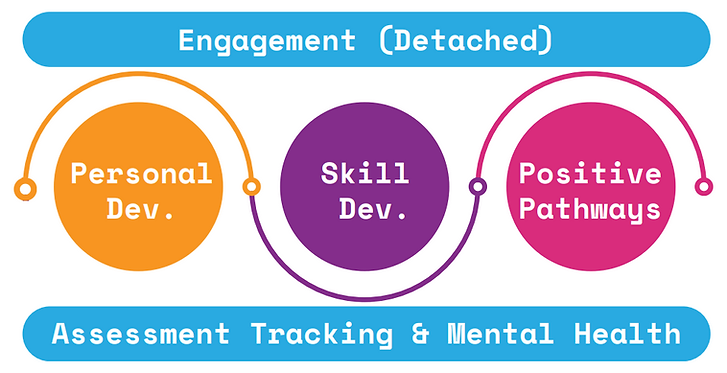

The Journey: End to End Support
00
Engagement via Detached Youth Work
Detached youth workers walk through estate engaging children and young people that have slipped through the net- underrepresented communities.
Communities that are furthest away from the support they need.
01
Needs assessments, One-to-Ones and Mental Health
Children and young people are assessed to understand their needs and hear about their dreams; this becomes the individual learning plan. Regular one-to-one sessions are used to track progression, provide mental health support and adjust our services.
02
Personal Development within Safe Spaces
Youth workers support children and young people to address those deep-rooted circumstances that are preventing personal development. We also cover those core skills that need to integrate (e.g. timekeeping, anger management).
03
Skill Development through Corporate Partners and Qualifications
Once children and young people have addressed those deep-rooted needs, we help develop aspirations through exciting excursions to interesting places. This naturally leads to an interest in developing skills.
04
Positive Pathways
At this point, children and young people are ready to explore the areas they are interested in, so our team focuses on supporting the transitions into this pathway. It may be a course, an extracurricular activity or employment.
The average time a beneficiary stays with us is over 5 years!
Hear from young people
Read some more...
Read about how today's leaders have also once benefitted from our services.
Any recognition?
Ofsted Inspection of Youth Services
YOH, along with another organisation, was ranked first by an Ofsted Inspection.
The inspector noted our approach where young people lead their own learning.
2011
Mayor of London Award
Our Founder and CEO's work was recognised by the Mayor of London for his positive contribution in improving the lives of Londoners.
Independent Evaluation: "Best results of all providers"
Our NEET work that halved NEET figures was recognised: “The community-based organisation that prevailed (YOH) had the best results of all providers."
Chartered Institude of Fundraising - Small Charity Award Finalist
The time and effort made in pulling together a stakeholder approach impressed the judges. Furthermore, the importance given to future sustainability stood out.
Juliette Gimon Courage Awards - Winner
Recognises organisations that have passionately prioritised the safety and care of children in vulnerable circumstances, including facing violence and exploitation.